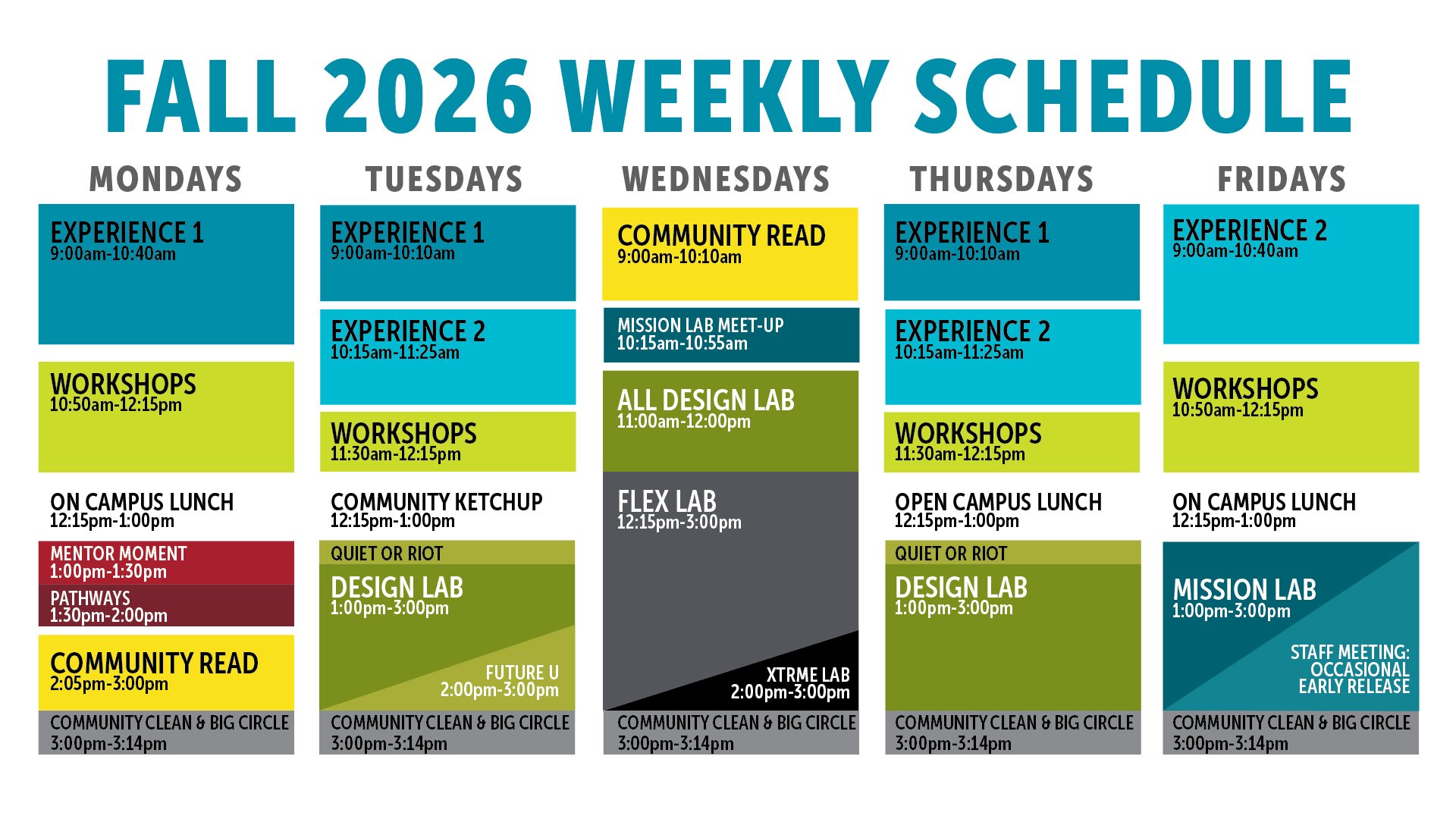
Every year, the One Stone weekly schedule changes. It changes based on student and staff feedback, organizational goals, and the spirit of innovation. This requires students and staff to adapt and actively learn to manage their schedules.
The Fall Schedule will run for a total of 10 weeks, from September 21 to December 10.
No Late Start on Thursdays - For the past several years, staff meetings were held weekly on Thursday mornings during late start. Late Start is not in the schedule this term because One Stone no longer requires every student to engage in Project Good after school each term; instead, students must lead or meaningfully participate in at least one Project Good prior to graduation.
Early Release on Two Fridays - Staff meetings and professional development will now be held on Friday afternoons in the fall. Students will be released at 12:15 and the building will be closed to students on the following days:
Fri, Oct 2, 2026
Fri, Nov 6, 2026
Experiences (or Experiential Learning) – Engaging, hands-on, project-based learning where coach or specialist expertise meets student curiosity and passion. Experiences have a specific academic focus (science, technology, engineering, math, language arts, social science, computer science, art) and are often multi-disciplinary and real-world relevant. Learning and projects are designed around student voice, choice, and defined goals for academic and durable skills growth.
Workshops – Focused academic skill-building sessions led by specialists or coaches who help students practice and develop problem solving techniques or gain understanding and confidence with a specific topic. All Fall 2026 Workshops will be math focused. Additional time is provided on Mondays and Fridays, encouraging more real-world and project-based learning.
On Campus Lunch – Students stay on campus to eat, keeping the community together over the meal. Students will often schedule mentor meetings with their mentors during On Campus lunch times.
Open Campus Lunch – Students have the freedom to leave campus for lunch (human-powered by foot or pedal only), reflecting the school's trust in student autonomy. Students will often schedule mentor meetings with their mentors during Open Campus Lunch times.
Community Ketchup – On Tuesdays, students and staff will gather, "catch up,” and have some fun. Bring your own food, but the ketchup will be provided. Each Community Ketchup will have a different focus and students will brainstorm, discuss, and workshop topics and issues that are important to them. This is an opportunity for students to identify problems and develop solutions for issues that have historically only been repeatedly announced during Big Circle.
Mentor Moment – Group time with a mentor focused on a student's personal, academic, and emotional growth.
Pathways – Dedicated time for graduating class cohorts to explore and plan their individual paths to graduation, post-graduation, college, and career direction. Pathways will also feature individual and group goal setting, planning, and reflection activities.
Community Read – Small-group literature discussions run in a book-club style to build shared reading and conversation skills.
Design Lab – Real-world, challenge-based project work where students apply human-centered design thinking with community partners, progressing from XLab (introductory design thinking for incoming learners) to DLab (team-based problem solving with community partners) to YLab (a final, autonomous nine-month project with a community partner).
Quiet or Riot – The first few minutes of Design Lab time will be left up to chance. Will it be a calm, peaceful, and introspective moment or a high-energy release of pent up emotions? Only the music gods will know for sure…
All Design Lab – The whole school practices various design thinking skills, strategies, or design challenges, reinforcing design thinking as a shared, community-wide practice. All Design Lab is sometimes used for team or project work, peer coaching, or preparation for signature events.
Future U – Held for the graduating class of 2027, Future U is a Language Arts experience that supports students on their plans after graduation, and focuses heavily on the writing and revision process of the personal essay. This one-hour block is held for group and individual college and career counseling. In addition to this weekly time block, students will also attend college essay writing nights and receive 1-1 counseling.
Flex Lab – Open, self-directed work time for students who submit a Flex Lab plan. There are 3 Flex Lab pathways: Professional, Creative, Inquiry, or External Academic. Flex Lab is not a transcripted experience and allows students time, space, resources, and freedom to explore a curiosity, passion, or goal.
XTRME Lab – A specialized, individually-paced track within Flex Lab for select students to develop and practice a mysterious and powerful set of skills.
Mission Lab – A student-driven, project-based, language arts experience that is designed to make students better leaders and the world a better place. Students will apply to join a defined project team that will provide student-driven leadership opportunities that benefit our larger community and One Stone. Due to a variety of events, presentations, and staff meetings, Mission Lab project teams will meet on Wednesdays and four Fridays throughout the fall term:
Fri, Sep 25, 2026
Fri, Oct 9, 2026
Fri, Oct 23, 2026
Fri, Nov 13, 2026
Mission Lab should prototype or implement at least once during the term and should somehow work to drive retention, recruitment, and/or revenue for One Stone. There will be 3 writing and reading requirements for completion.
Community Clean & Big Circle – Working in Mentorship Groups, the community tidies specific areas of the building, then gathers as a whole group to close out and reconnect before heading home. Important note: Big Circle is a space for connection, celebration, and important announcements, NOT a time for problem sharing or problem solving.